Blog
We compare the UK Official Charts Company streaming / download chart and UK radio plays for the first half of 2026 with what we've seen in the UK’s largest ever set of public performance data
26th August 2026
Introduction
A year ago we did something that had never been done before: we put a UK Public Performance Top 40 side-by-side with the Official Chart and radio airplay, and asked how much the three actually had in common. The answer was: less than anyone expected.
The UK Official Charts Company has now published their chart for the most-streamed and best-selling tracks of 2026 so far, covering January to the end of June. It remains the definitive picture of what people listen to privately - on headphones, at home, or on the go.
So now we can run the comparison a second time - one year of data tells you what public listening looks like; two tells you whether it's a quirk or a pattern. We can also look at whether the gap between private and public listening is closing or widening.
Our Audio Meters are in more UK venues than they were twelve months ago, which makes this the largest and most accurate dataset of public performance plays ever compiled - the music actually playing in the bars, cafés, shops, gyms, hotels and restaurants around us.
Here's the headline: it wasn't a quirk, and the gap got wider!
Overlaps
Line the three charts up and the overlaps are smaller than last year across the board.
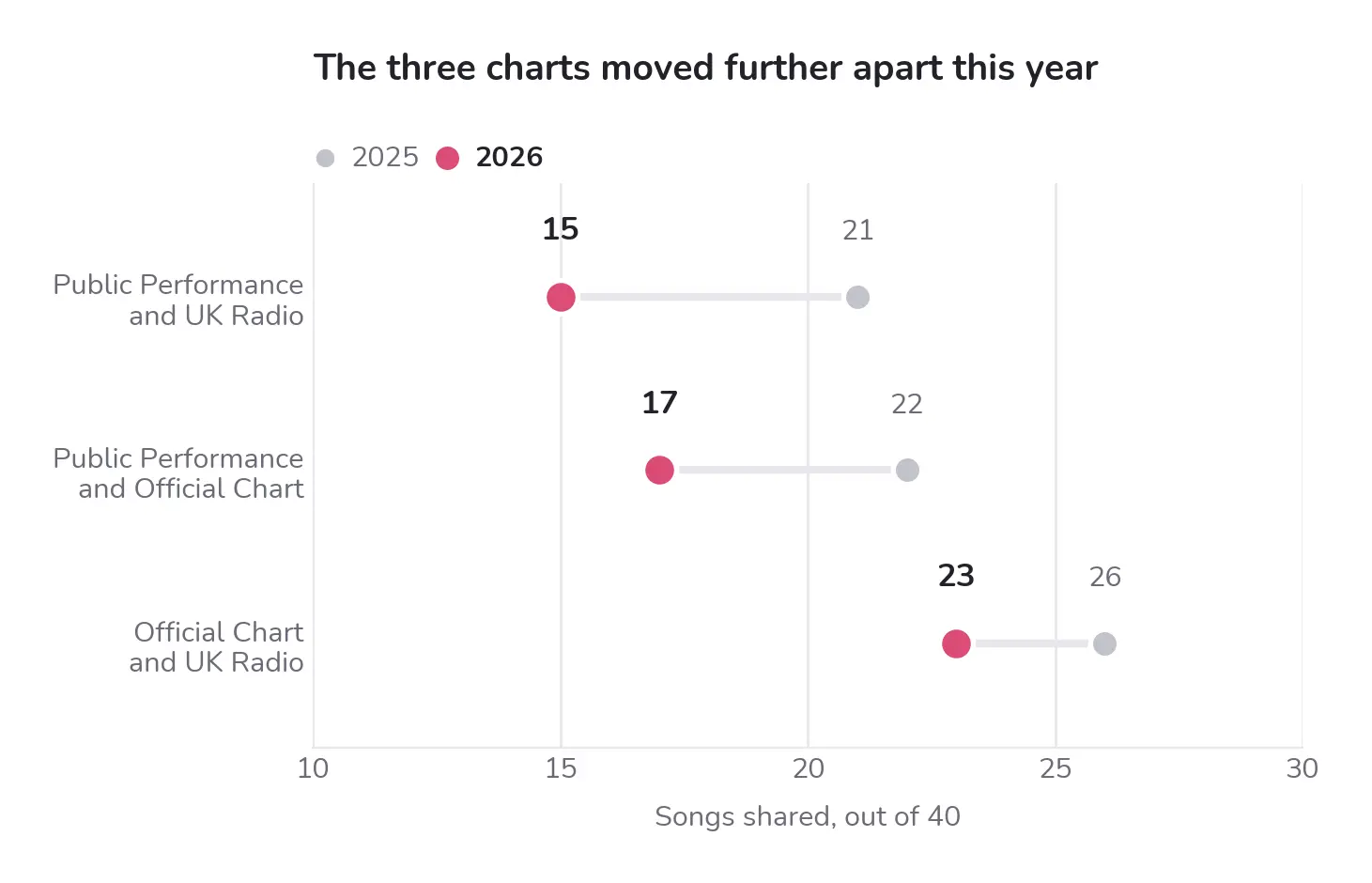
Fewer than half of the songs in our Public Performance Top 40 appear in the UK Official Chart (17 out of 40, down from 22) or the UK Radio chart (15 out of 40, down from 21).
Even the two charts you'd expect to agree have drifted apart: the UK Official Chart and the Radio chart now share 23 out of 40 songs, down from 26.
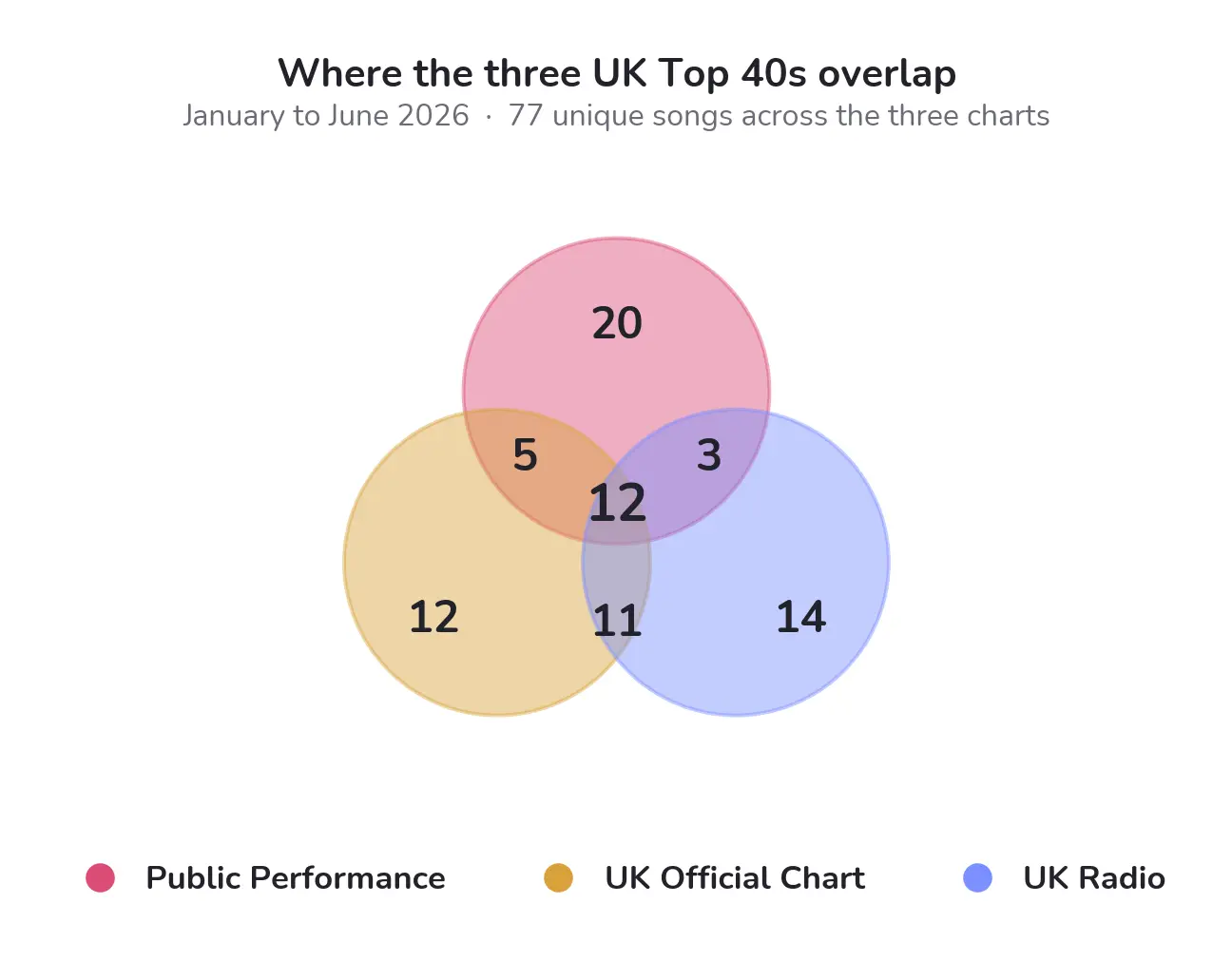
Only 12 songs managed to appear in all three Top 40s. It takes 77 different songs to fill three charts of forty:
Put the two years next to each other and every single overlap has shrunk:
You might reasonably assume that as streaming becomes more dominant, everything converges on it. The data says the opposite: public listening isn't a slower version of the streaming or radio charts, it's an entirely different ecosystem.
Recent vs Classic songs
As we found last year, the clearest indicator is in the release dates. Venue playlists are built for mood, atmosphere and familiarity, not for novelty, so they reach further back in time.
The Top 40 UK Radio Chart is almost entirely a chart of the 2020s - 38 of its 40 songs.
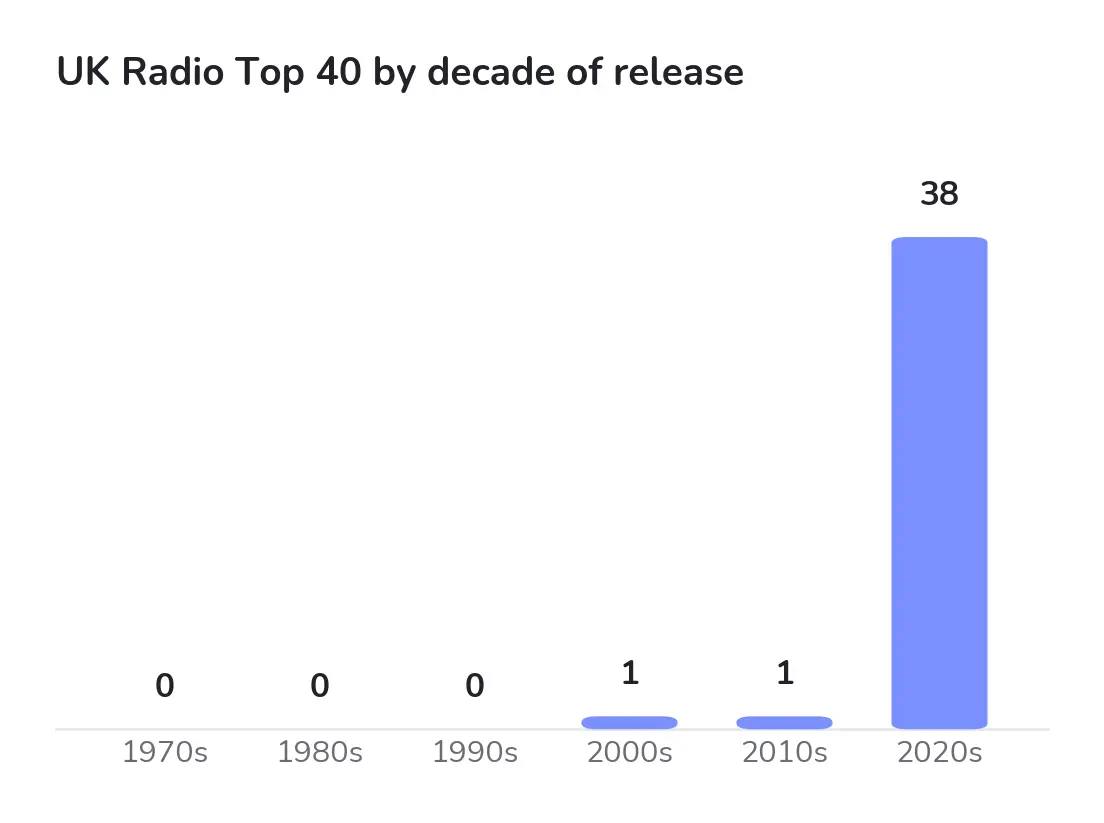
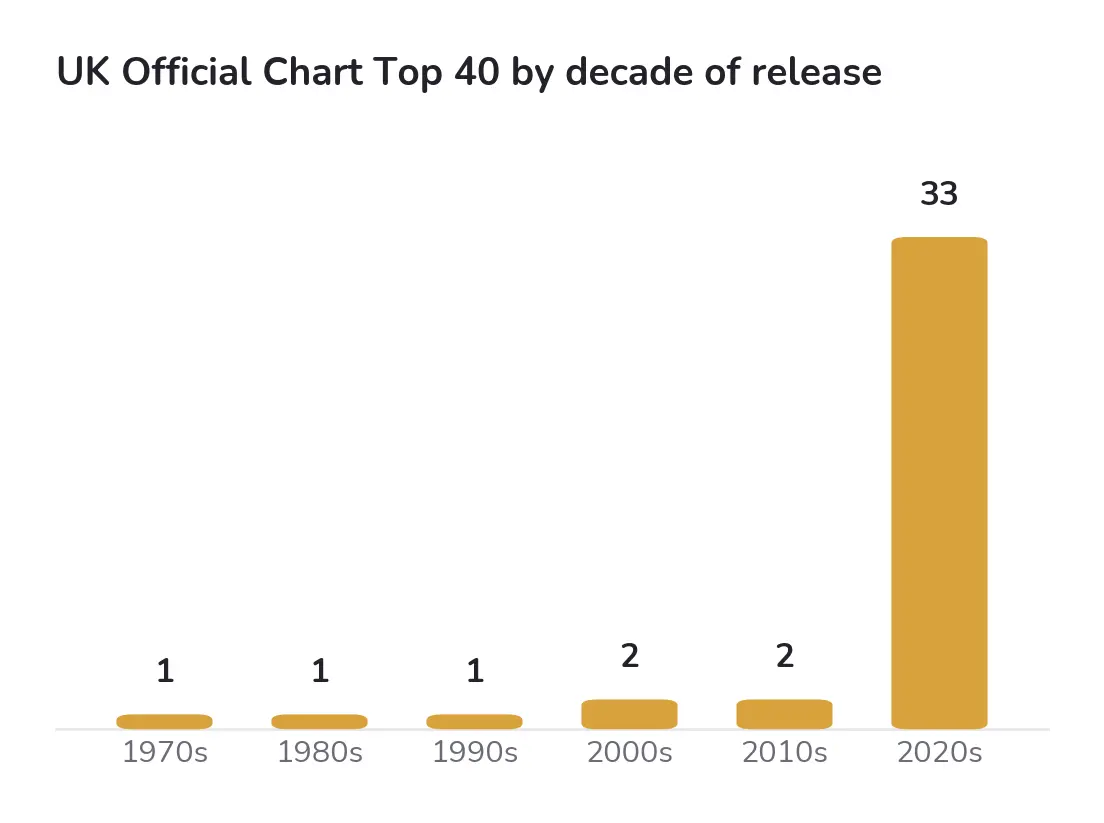
The Top 40 Official Streaming and Download Chart is a little broader, with 33 songs from the 2020s and a scattering of older tracks - one each from the 1970s, 1980s and 1990s, two from the 2000s and two from the 2010s:
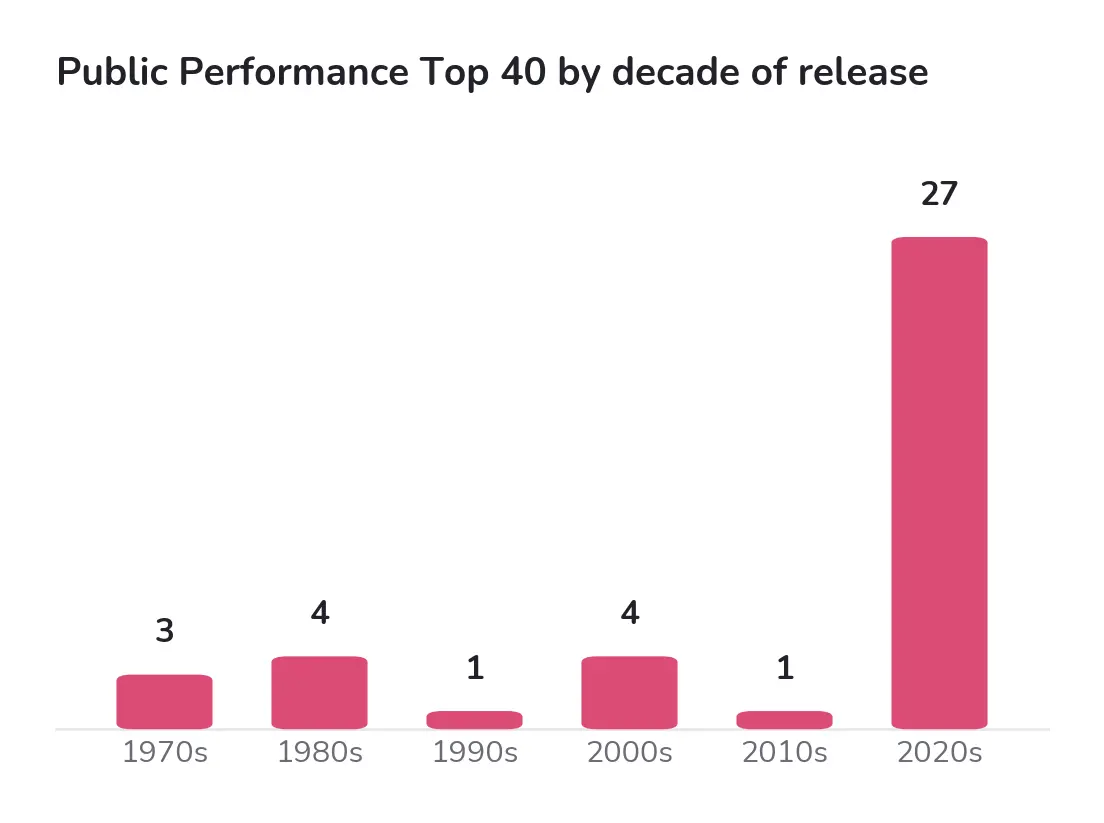
Public performance is, once again, by far the most varied. Thirteen of its forty songs were released before 2020, spread across every decade from the 1970s onwards:
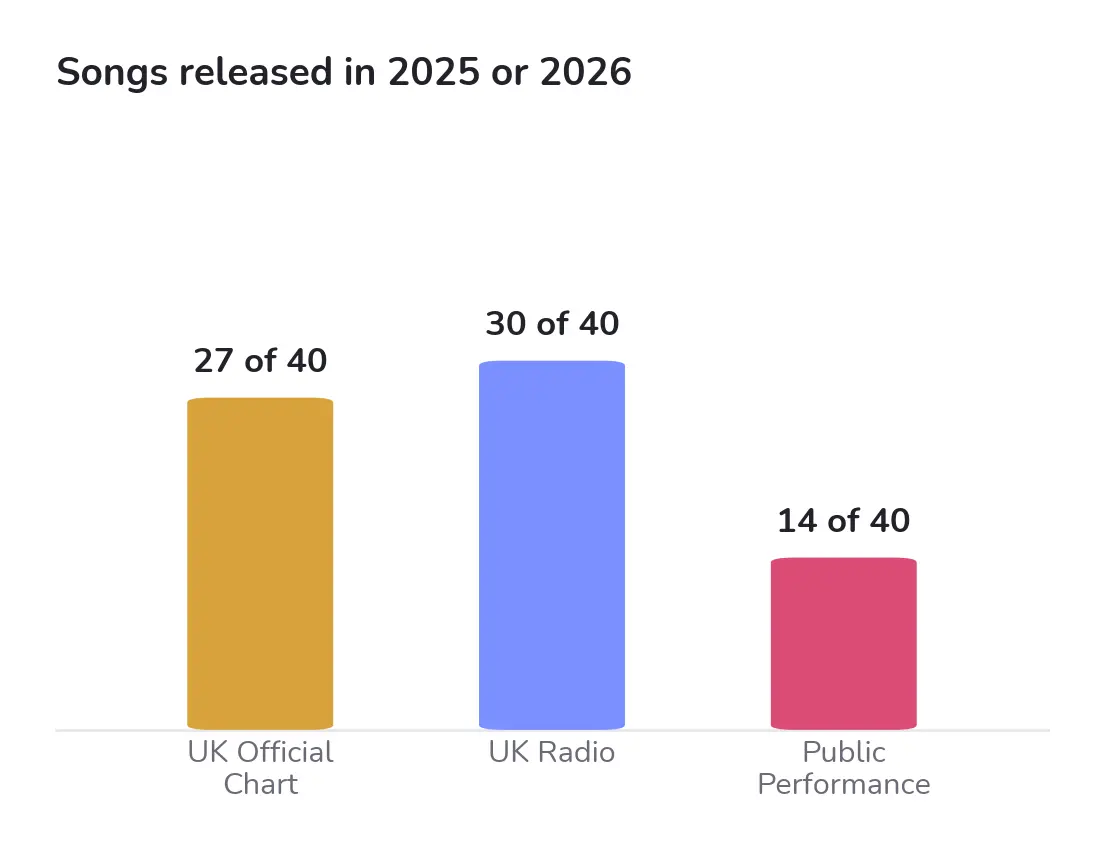
The same gap shows up if you ask a simpler question - how much of each chart is genuinely new music? 30 of the 40 radio songs and 27 of the 40 Official Chart songs were released in 2025 or 2026. In Public Performance it's just 14 out of 40:
That balance between fresh hits and enduring favourites was the story last year and we're seeing the same things this year.
Trends
The interesting cases are the songs that are huge in one world and barely register in another.
Bella Kay's iloveitiloveitiloveit is the seventh biggest song of the year on the Official Chart and reached number 33 on radio, yet in Public Performance it sits at number 316.
Even starker, Just The Way You Are by Milky, a 2002 dance record given a second life on TikTok, is number 17 on radio and number 27 on the Official Chart - but number 2,029 in Public Performance.
The same is true of streaming revivals - Zara Larsson's Lush Life at number 10 on the Official Chart eleven years after release, yet only reaches number 359 in Public Performance.
The reverse is also true - Fleetwood Mac's Dreams was already high in the Public Performance chart last year at number 37, well before it appeared anywhere else. This year it's at number 6 and has now arrived in the Official Chart at number 34. The Chain joins it at number 29 in Public Performance. We're not going to claim we predicted it, but public spaces were playing that track long before the streaming chart noticed!
None of this looks like Public Performance "catching up" with streaming and radio. It's following its own path and occasionally getting somewhere first.
Classics
You'll hear loads more classic songs played in pubs, bars, hotels, restaurants and other premises that simply aren't represented by streaming or radio playback. Twenty of the Public Performance Top 40 appear in neither of the other two charts at all - among them Tears for Fears (Everybody Wants To Rule The World, 1985), Luther Vandross (Never Too Much, 1981), Whitney Houston (I Wanna Dance with Somebody, 1987), Journey (Don't Stop Believin', 1981) and Franz Ferdinand (Take Me Out, 2004).
As with last year, our Public Performance Top 40 accounts for just a small amount of the plays we've recognised in the first half of the year. This year it's only 1.8% - down from last year's 2.2%. Ninety-eight percent of public listening happens below the chart - millions of plays for smaller artists and back-catalogue tracks that no other measurement picks up.
Without our Audio Meter data, that long tail of music would remain completely invisible - and the artists behind those songs wouldn't get the recognition or royalties they deserve.
The Charts
Now, without further ado, here are the songs that made up the first half of 2026 across the UK Official Charts, radio and Public Performance plays. You can click the column headers to sort by the chart positions and explore the relative positions across the charts. A handful of songs can't be placed in every chart - the Official and radio charts only publish a Top 40, so anything outside theirs is marked N/A...
Summary
For years, music charts have been defined by streaming, physical and digital sales, and radio play. Public performance - the soundtrack to our shared spaces - never had a seat at the table, because nobody could measure it.
Two years of comparisons in, we can say something we couldn't say last year with only one. This isn't a rounding error or a one-off: public listening has its own logic, its own classics and its own hits, and over the past twelve months it has drifted further from streaming and radio rather than closer.
I hope you've enjoyed digging into these charts. It turns out that public performance, streaming, radio play and physical sales are still really nothing alike - and the distance between them is growing.
Steve Robbins, CTO